
The U.S. Army Pacific (USARPAC) is interested in finding and developing capabilities that work for the Warfighter by experimenting early, often, and in-theater.
Allows small businesses to submit to Direct to Phase II applications if they performed the Phase I research through other funding sources.
The U.S. Army Pacific (USARPAC) is interested in finding and developing capabilities that work for the Warfighter by experimenting early, often, and in-theater.
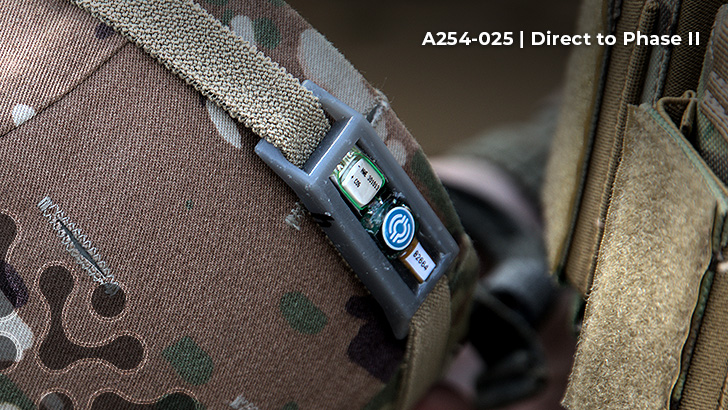
The goal of this topic is to develop a wearable (integrated into kit or stand-alone applique) that measures 360-degree blast exposure to the wearer.
Wearable Sensors to Monitor Environmental and Occupational Impacts to Brain Health Read More »

This platform will integrate tools and best practices in a central portal to modernize the Army’s acquisition process, supporting both Business-to-Business (B2B) and Business-to-Consumer (B2C) needs
AI-enabled Portfolio Management Read More »

Provide a comprehensive software-as-a-service (SaaS) solution that automates and standardizes the evaluation and source selection processes while tailoring the user experience to the Army’s unique conditions/constraints.
AI Enabled Source Selection Solution for Contract Proposal Evaluation Read More »
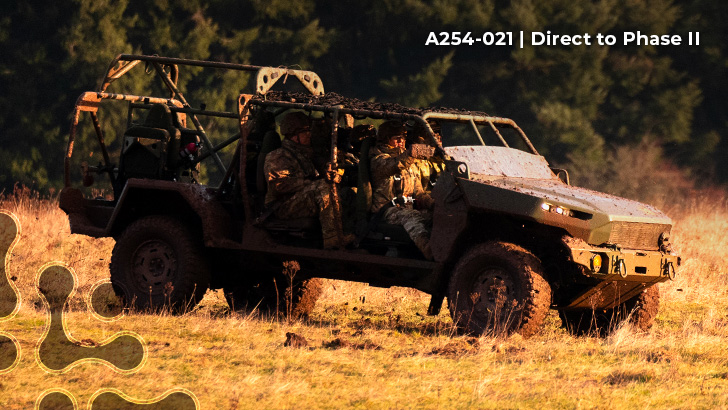
Vehicle drivers could benefit from sensor systems that provide enhanced awareness of the vehicle surroundings and improve the driver’s ability to operate the vehicle in Degraded Visual Environments (DVE), such as nighttime or low-visibility weather conditions.
Ruggedized Sensors to Increase Driving Visibility and Vehicle Safety Read More »

Develop and integrate Artificial Intelligence (AI) technology that can augment current and future sensor hardware enhancing the ability of the driver to maneuver and operate large, heavy, ground combat vehicles.
Artificial Intelligence for Aided Driving of Ground Combat Vehicles Read More »

Organizations across various sectors are increasingly inundated with vast amounts of data, making it challenging to identify and analyze anomalies and patterns effectively.
Novel AI Techniques for Insights in Various Environments (NATIVE) Read More »

Operating, maneuvering, engaging, defending, and commanding the Combat Vehicles on the modern battlefield requires a significant level of crew communication, systems management, and situational awareness.
AI/ML-Enabled Voice-Commanded Autonomous Maneuver for Ground Combat Vehicles Read More »

The objective of this effort is to develop a hardware and software solution to capture, process, and measure key parameters of the chaotic, high-speed, propellant development experiments in challenging real world lighting conditions. It is important because it will lead to advancements in propelling charge design that will enable greater range of artillery weapon systems in development and simultaneously increasing both the lethality and the safety of Soldiers utilizing propellants designed with this technology.
Computational Analysis of Event Camera Imagery for Propellant Testing Read More »

The Explosive Ordnance Disposal Visual Ordnance Identification Database (EODVOID) will develop an automated photogrammetry method to greatly increase the speed of scanning and creating 3D models for 1000’s of pieces of ordnance samples. This would enable the development of a much-needed authoritative ordnance database and serve as a baseline standard for training and developing AI/ML detection and classification algorithms.
Explosive Ordnance Disposal Visual Ordnance Identification Database (EODVOID) Read More »