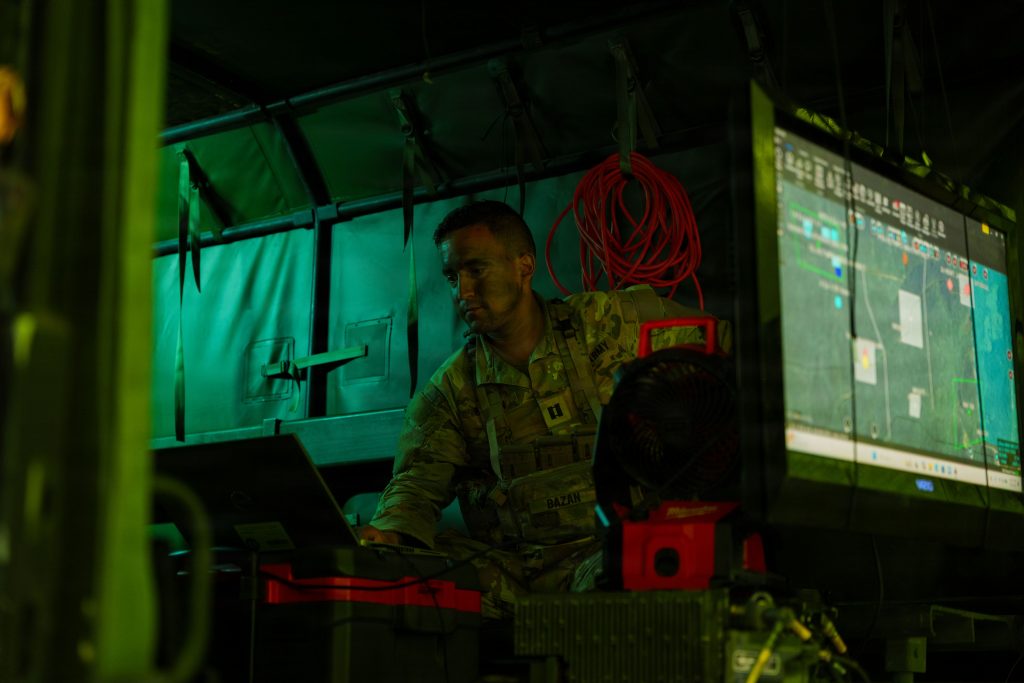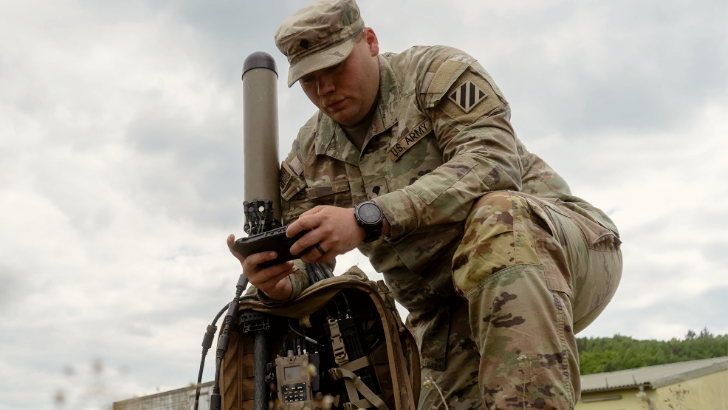
Develop and demonstrate Command Electromagnetic Management & Command-node Awareness, Management, and Obscuration (CEMA CAMO), a low-cost, distributed, and attritable electromagnetic spectrum capability that enhances Command Post Survivability and RF Signature Management during Large-Scale Combat Operations (LSCO). The desired capability will employ distributed, software-configurable nodes to sense and shape the electromagnetic environment, creating controlled electromagnetic ambiguity that complicates adversary intelligence, surveillance, and reconnaissance (ISR), reduces targeting confidence, and degrades adversary decision-making and targeting cycles while preserving friendly freedom of maneuver. The capability will be demonstrated in partnership with Joint Innovation Out Post (JIOP) through XVIII Airborne Corps (XVIII ABC) experimentation to assess operational effectiveness, inform capability refinement, and demonstrate integration with Army formations and command-and-control architectures.

Phase I
Is the opportunity to establish the scientific, technical, commercial merit and feasibility of your proposed innovation.
xTech|Search 10 Competition
The SBIR|STTR Program has aligned technologies that are experiencing rapid commercial traction with critical Army priorities into four portfolios of priority interest for this competition, each with core technology components identified.
xTech|Search 10 Competition Read More »
Agentic-AI, Schema-Driven Decision Management for Auditable Studies and Acquisition Decisions
Prove a decision-as-a-program capability that turns complex engineering/acquisition questions into structured, auditable Decision Packages – faster, with higher confidence. This opportunity will be open for both SBIR and STTR participation.
Asymmetric Collaborative Counter Swarm
Develop and integrate a distributed Artificial Intelligence (AI) technology that can collaboratively command and control a multi-agent Group 1 or Group 2 Unmanned Aerial System (UAS) swarm to defend an area against a numerically superior enemy swarm. AI system must be able to interface with existing, standard platform autonomy and perception systems. System must also not rely on a centralized control node.
Asymmetric Collaborative Counter Swarm Read More »
xTech|Inversion Competition
The U.S. Army is seeking information from eligible small businesses across the U.S. to identify and advance commercialization pathways for a curated portfolio of high-potential Army Intellectual Property (IP) sets through the xTech|Inversion competition. This platform offers participants the opportunity to engage with the Department of War (DoW), earn prize money and submit a Phase I Army SBIR proposal.
xTech|Inversion Competition Read More »
Multifrequency Position, Navigation, and Timing (PNT) Antenna Solution
The modern battlefield includes Electronic Warfare (EW) targeting a variety of RF signals, making single-frequency systems vulnerable to brute-force jamming. PGMs require frequency diversity in small, gun hardened, PGM Form Factor (FF) patch antennas to support a variety of M-GNSS and SoOp PNT signals and ensure successful operations in a contested EW environment.
Multifrequency Position, Navigation, and Timing (PNT) Antenna Solution Read More »
Scalable Agile Manufacturing of Launched Effects
Uncrewed aircraft systems (UAS) are expected to play an increasingly significant role on the future battlefield. Launched Effects (LEs) are UAS launched from a tube either from air or ground platforms and can perform a variety of missions.
Scalable Agile Manufacturing of Launched Effects Read More »
The xTech|Phantum Competition
The U.S. Army is seeking innovative quantum sensor and photonics solutions from eligible small businesses across the U.S. through the xTech|Phantum competition. This platform offers participants the opportunity to engage with the Department of War (DoW), earn prize money and submit a Phase I Army Small Business Innovation Research (SBIR) proposal.
The xTech|Phantum Competition Read More »
Modular Payloads for UAS
The objectives for this effort are to enhance and refine various payload types and integrate them using a modular specification for unmanned aircraft systems (UAS). Experimentation, testing, and evaluation for this effort will use a Soldier-centered iterative design process.
Modular Payloads for UAS Read More »
In Transit Visibility Blockchain
This topic seeks to develop and optimize a real-time In-Transit Visibility (ITV) system that enables military commanders and logistical staff from Corps to Battalion level to overcome limitations in tracking and managing the movement of supplies and personnel through the integration of data from various enterprise systems and sensor technologies.
In Transit Visibility Blockchain Read More »